Premium vs Value Generic Drugs: Quality, Pricing & OTC Brand Reliability

Table of Contents
- The Official Xeteor 3-Tier Generic Quality System
- Quick Answer: How Xeteor Routes Generic Alternatives
- What is a Generic Drug: Premium vs Value Generic Drugs
- Understanding Our Generic Tiers: The Xeteor Curation Strategy
- Why Are Rugby and Major Pharmaceuticals Prices Increasing?
- How Third-Party Manufacturing Can Affect Generic Prices
- Why Perrigo and Other Tier 1 Brands May Have More Pricing Stability
- How Narrower Distribution Can Add Pricing Pressure
- Why Tier 3 Value Generics Aren't Always the Lowest Price
- Why are Rugby and Major Pharmaceuticals products more expensive in 2026?
- Can GoodSense or another generic brand cost less than Rugby or Major?
- The "Labeler" Concept in Action: Who Really Makes Your Antacid?
- Xeteor Substitution Map: Examples
- What Does "Compare to the Active Ingredient" Mean?
- What to Do When Generic Medications Go Out of Stock
- Premium vs Value Generic Drugs Summary: Xeteor Generic Brand Hierarchy
- Bottom Line: Premium vs Value Generic Drugs
- Looking for Zyrtec or Claritin Generic Comparisons?
- Find More About Premium vs Value Generic Drugs in Our Expert-Curated Hubs
- Premium vs Value Generic Drugs: Shop Brands Mentioned
- About Xeteor
- Frequently Asked Questions
Understanding the difference between premium vs value generic drugs is no longer just about price. It's about choosing the right generic based on active ingredient, use case, delivered price, package size, manufacturer reliability, and real-world availability.
At Xeteor, we use a 3-Tier Generic Quality System to help shoppers understand the difference between Tier 1 Premium Generics, Tier 2 Standard Generics, and Tier 3 Value Generics. One important distinction is who actually manufactures the medication versus who sells it under their label. As we explain in our Who Makes Store Brand Medicine? guide, many familiar pharmacy and store-brand medications are produced by manufacturers operating behind the scenes. Understanding these relationships helps explain why generic brands can differ in sourcing, availability, and price. Our tier system also serves as our generic substitution map: the framework we use when products become expensive, unavailable, discontinued, or difficult to source consistently.
October 2026 Update: Why Some Tier 3 Generics Cost More
Updated October 2026: Reflecting wholesale cost increases Xeteor has observed on selected Rugby and Major products, alongside changes in sourcing and availability.
Important: Tier 3 Value Generic describes a legacy value-label sourcing approach, not inferior medicine or a guarantee of the lowest price. During 2026, Xeteor has experienced substantial wholesale cost increases on selected Rugby Laboratories and Major Pharmaceuticals products. In comparison, many products from our other suppliers have maintained more stable acquisition costs. Our tier system helps shoppers choose based on formula, availability, sourcing reliability, and delivered value rather than historical brand reputation alone.
The Official Xeteor 3-Tier Generic Quality System
This guide is the official standard for the Xeteor 3-Tier System used across our product pages, hubs, comparison guides, and generic alternative articles. It defines Tier 1 Premium Generics, Tier 2 Standard Generics, and Tier 3 Value Generics, and explains how we route shoppers when their usual generic is unavailable, overpriced, discontinued, or no longer the best practical value.
We don't carry every generic brand on the market. Instead, we curate products based on active ingredient match, manufacturing source, supply stability, package size, delivered price, and customer use case. Look for the Quality Checks on our product pages to understand the sourcing category:
- ✅✅✅ Tier 1: Premium Generics (Manufacturer-Backed Stability), including GoodSense and Foster & Thrive.
- ✅✅ Tier 2: Standard Generics (Institutional, Specialist, and Healthcare-Supply Alternatives), including Geri-Care, Health Star, Reliable 1, and Oncor.
- ✅ Tier 3: Value Generics (Legacy Pharmacy Labels and Price-First Options), including Major and Rugby.
This guide explains how the tiers work, when each makes sense, and how Xeteor chooses practical alternatives when a generic becomes more expensive or difficult to find.
Quick Answer: How Xeteor Routes Generic Alternatives
| Situation | Usually Consider | Plain English Reason |
|---|---|---|
| Tier 3 is available and priced well | Stay with Major, Rugby, or another legacy pharmacy label | A familiar Tier 3 product can still offer excellent value when the formula and total price make sense. |
| Tier 3 becomes expensive or hard to source | Consider Tier 2: Geri-Care, Health Star, Reliable 1, or Oncor | Institutional and specialist alternatives may offer more reliable availability and better delivered value. |
| Customer prefers familiar retail packaging or large-scale supply backing | Consider Tier 1: GoodSense or Foster & Thrive | Manufacturer or major distributor backing can provide a useful alternative sourcing route. |
| Exact formula is unavailable | Match the use case and clearly explain differences | We don't describe two formulas as identical when their active ingredients or strengths differ. |
| Single package offers poor value | Consider multipacks, institutional quantities, or bulk options | For repeat-use products, a larger quantity may lower the total delivered cost per unit. |
Xeteor Routing Rule
How We Route Premium, Standard, and Value Generics
Tier 3 doesn't mean worse, and Tier 1 doesn't always mean more expensive. We evaluate active ingredient, strength, intended use, availability, delivered price, and sourcing reliability.
If a Rugby or Major product remains competitively priced, it may still be the best value. When prices rise or availability becomes unreliable, we look for appropriate alternatives from Tier 2 or Tier 1 brands.
Joe's Translation: Premium vs Value Generics
- The Formula: Start with the active ingredient and strength. Then compare manufacturer or labeler, sourcing model, package size, delivered price, and availability.
- Plain English: Tier 1 doesn't always mean the highest price, Tier 2 doesn't mean middle-quality medicine, and Tier 3 doesn't mean worse medicine. The tiers describe how Xeteor evaluates brand sourcing and practical value.
- Reach for this when: Your usual generic has become expensive, difficult to find, or discontinued, and you need to identify a suitable replacement.
What is a Generic Drug: Premium vs Value Generic Drugs
Before comparing Premium, Standard, and Value Generics, it helps to understand what a generic medicine is. A generic drug is designed to have the same active ingredient, dosage form, strength, route of administration, and intended use as its reference brand-name medication. Specific regulatory requirements depend on the drug category and approval pathway.
- Brand-Name Drugs: The original branded versions of a medication, often carrying higher prices associated with brand recognition and other commercial factors.
- Generic Drugs: Products using the same active ingredient and strength as the referenced medication, usually at a lower price.
Understanding Our Generic Tiers: The Xeteor Curation Strategy
At Xeteor, we don't simply list products. We map them. Our selection is curated based on active ingredients, formulation, manufacturer or labeler, supply stability, customer use case, and delivered value.
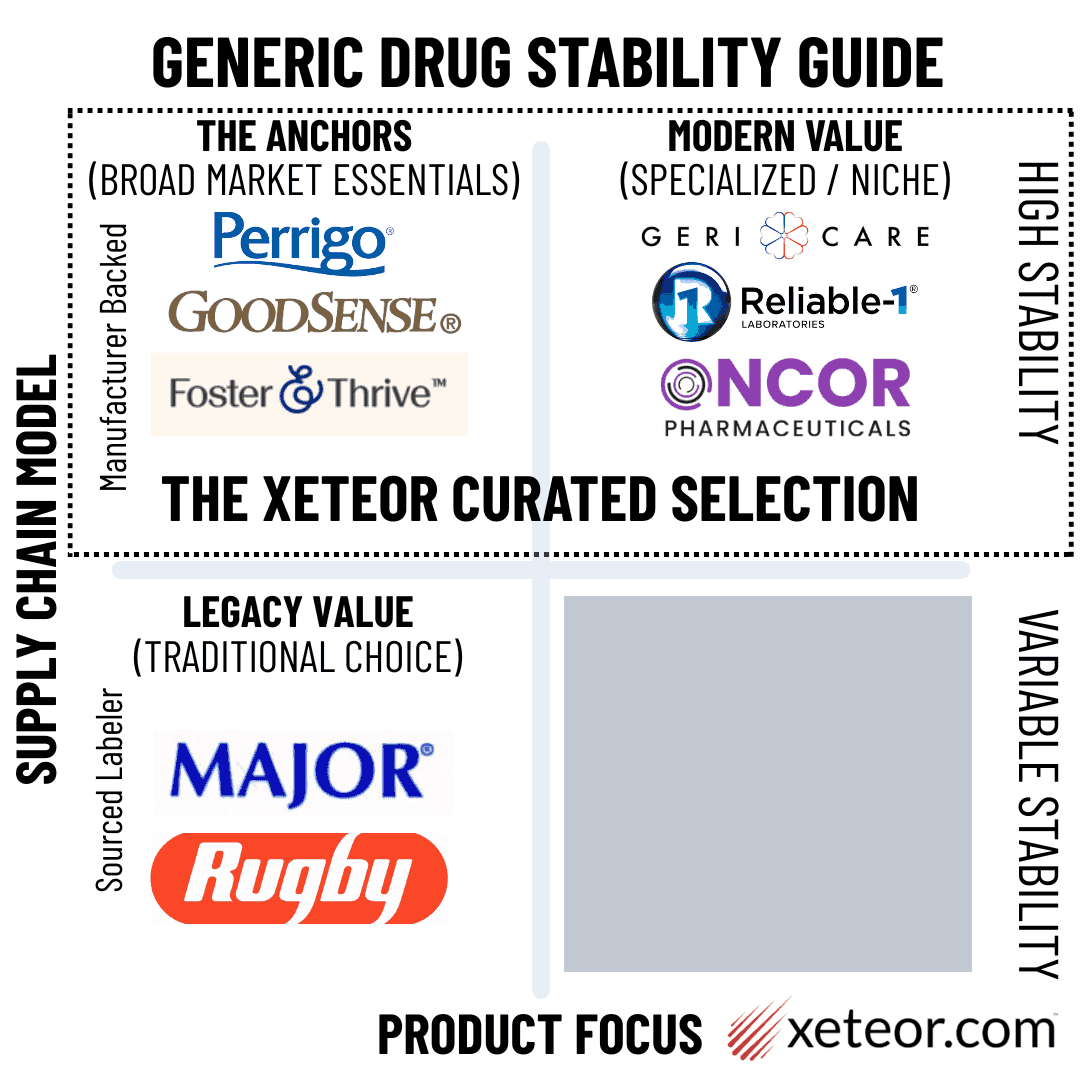 Our strategic framework comparing manufacturer-backed sourcing with legacy sourced-label models.
Many store-brand medicines sold by major retailers are produced by large manufacturers behind the scenes. Learn more in our Who Makes Store Brand Medicine? (CVS, Costco, Amazon & More) guide.
✅✅✅ Tier 1: Premium Generics
(Manufacturer-Backed Stability)
Tier 1 Premium Generics represent OTC products backed by major healthcare manufacturers, established retail supply networks, or large healthcare distributors. These brands may offer strong supply reliability, consistent product specifications, and familiar consumer packaging.
Tier 1 doesn't automatically mean the highest price. In some categories, Xeteor can source Tier 1 products more economically or consistently than legacy Tier 3 brands.
Many manufacturers involved in Tier 1 sourcing also produce store-brand medicines for major retailers.
GoodSense (Best for Stability)
Produced by Perrigo, one of the largest OTC manufacturers. GoodSense is Perrigo's consumer OTC brand, supported by manufacturing infrastructure also used to produce private-label medicines for major retailers.
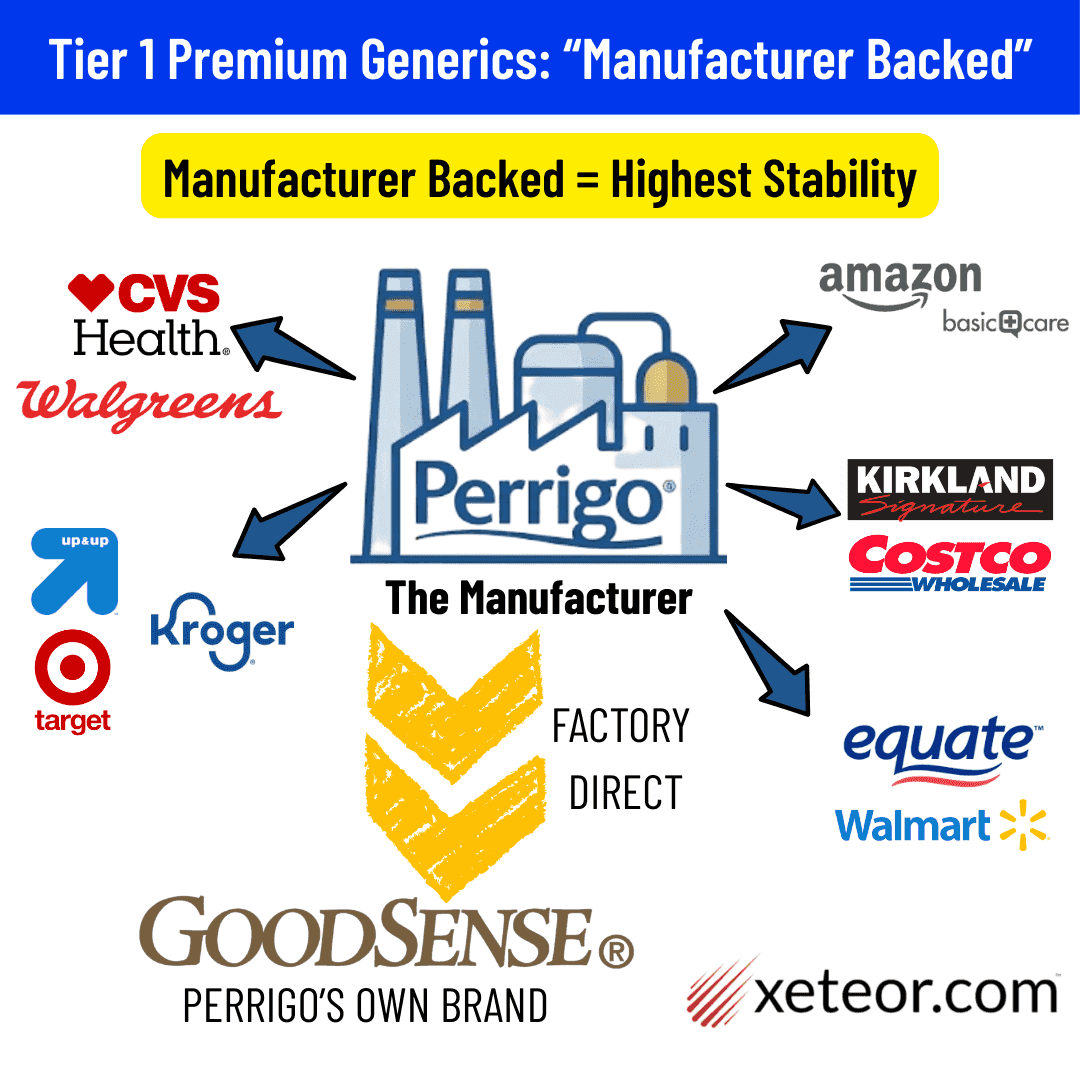 Perrigo's manufacturing infrastructure supports GoodSense and numerous private-label OTC products. Manufacturing capabilities provide a different sourcing model from brands that rely primarily on outside finished-product suppliers.
McKesson (Best for Healthcare Supply Chain Reliability)
McKesson is one of North America's largest healthcare distributors, supplying a wide range of medications and healthcare products to pharmacies, hospitals, clinics, and long-term care facilities.
McKesson consolidated its legacy Sunmark and Health Mart consumer brands into Foster & Thrive, its consumer OTC line.
McKesson's strength is particularly relevant to distribution scale and access. That should be distinguished from Perrigo's vertically integrated manufacturing capabilities.
✅✅ Tier 2: Standard Generics
(Institutional, Specialist, and Healthcare-Supply Alternatives)
Tier 2 Standard Generics include institutional healthcare suppliers, specialist brand lines, and established OTC companies serving pharmacies, senior care facilities, and other healthcare markets.
For many Xeteor customers, Tier 2 offers a practical balance of availability, bulk value, and specialized formulations. When a Rugby or Major product becomes too expensive or difficult to source, an equivalent Tier 2 product may provide better value.
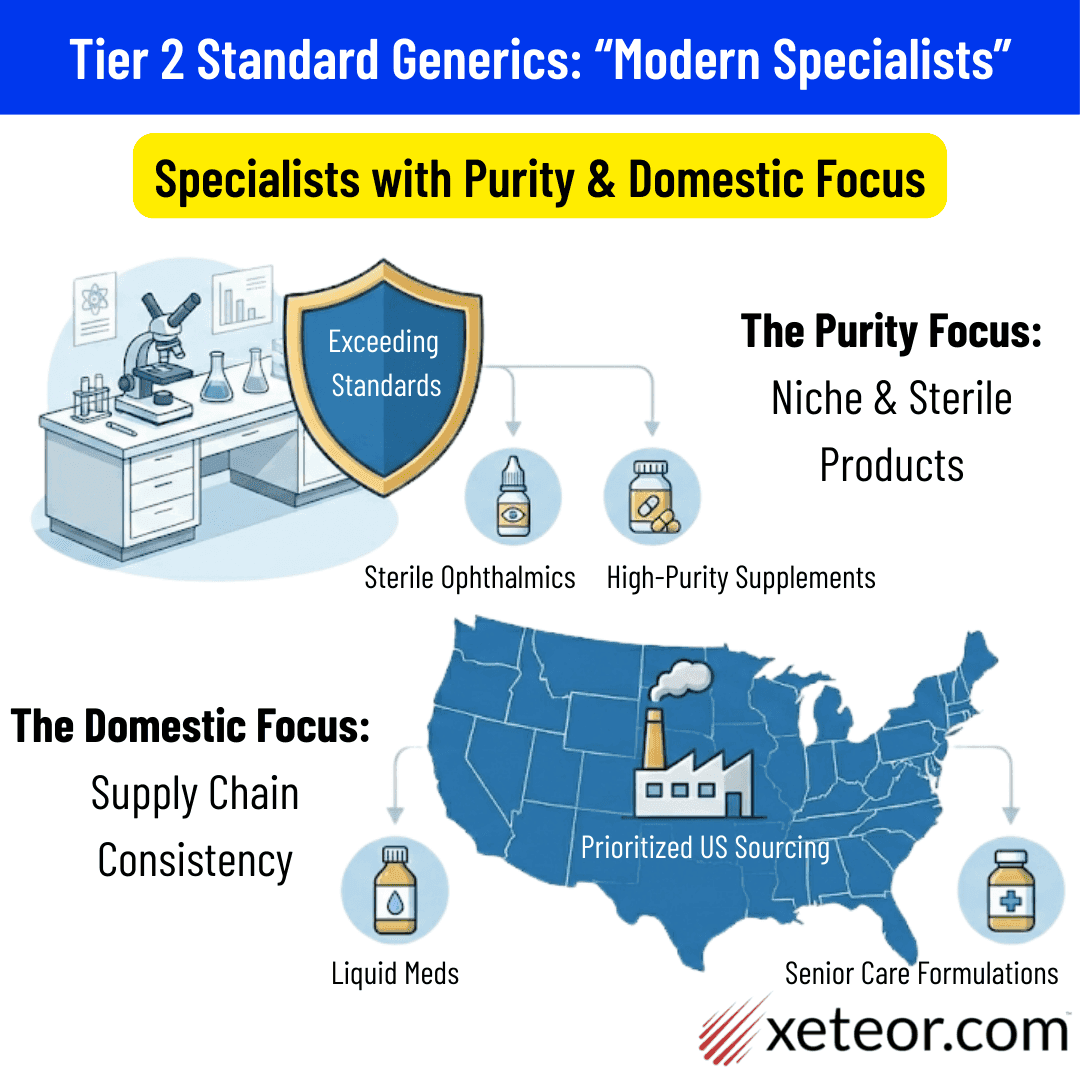 Tier 2 includes institutional and specialist alternatives that can help shoppers find appropriate products when traditional value labels become harder to source.
Geri-Care (Best for Institutional & Senior Care)
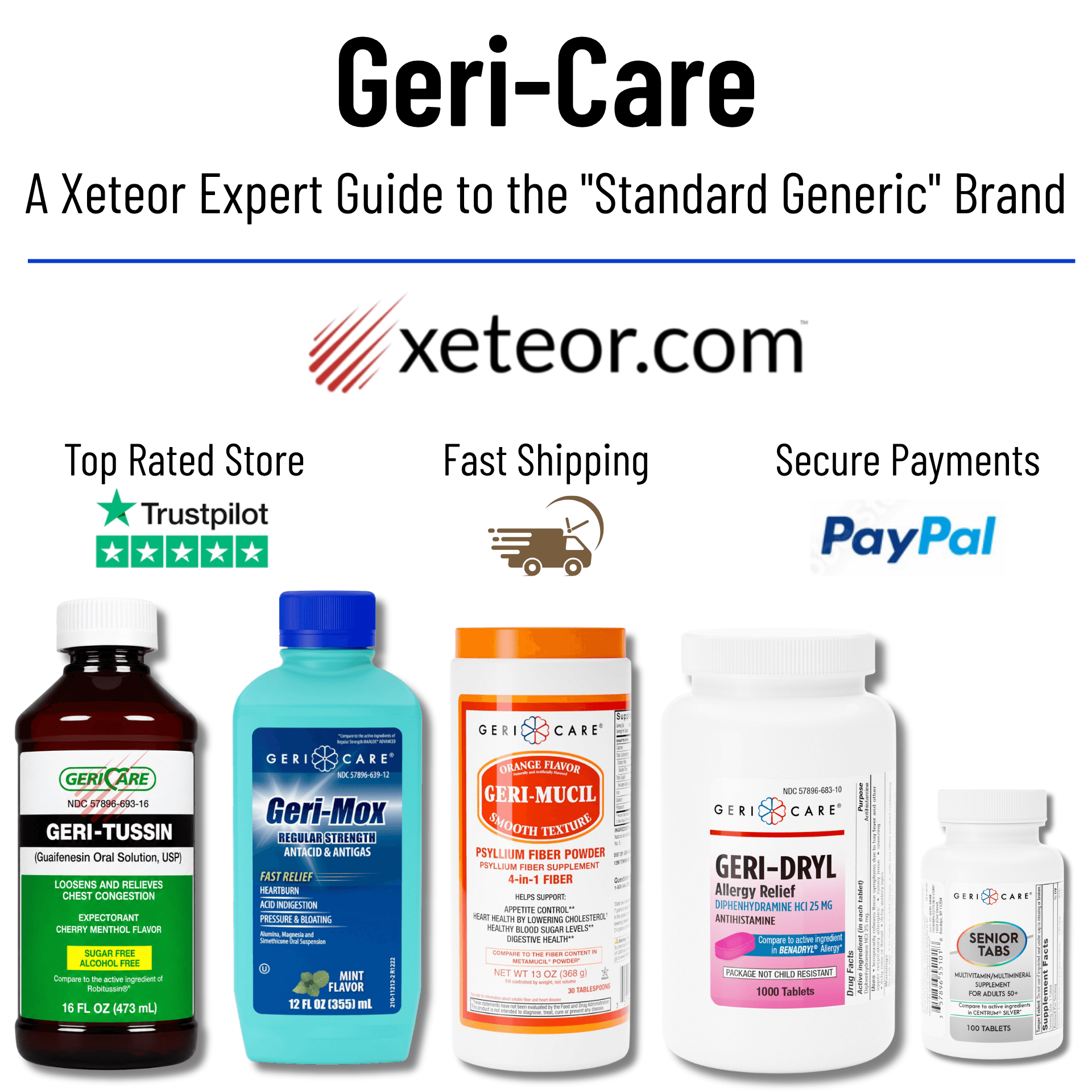
Geri-Care supplies numerous OTC medications and healthcare essentials for nursing homes, hospitals, long-term care facilities, and everyday consumers.
Many consumer-facing Geri-Care products are also marketed under the Health Star name, including commonly used OTC medications and supplements.
Reliable 1 Laboratories (Best for Specialty OTC & Supplements)
Reliable 1 offers OTC products and supplements, including specialty eye-care and saline formulations. It can provide an alternative sourcing route when familiar legacy brands become harder to obtain.
Oncor Pharmaceuticals (Best for Liquid OTC Alternatives)
Oncor offers liquid OTC medications and can provide another practical sourcing choice when legacy pharmacy labels are unavailable or expensive.
✅ Tier 3: Value Generics
(Legacy Pharmacy Labels and Price-First Options)
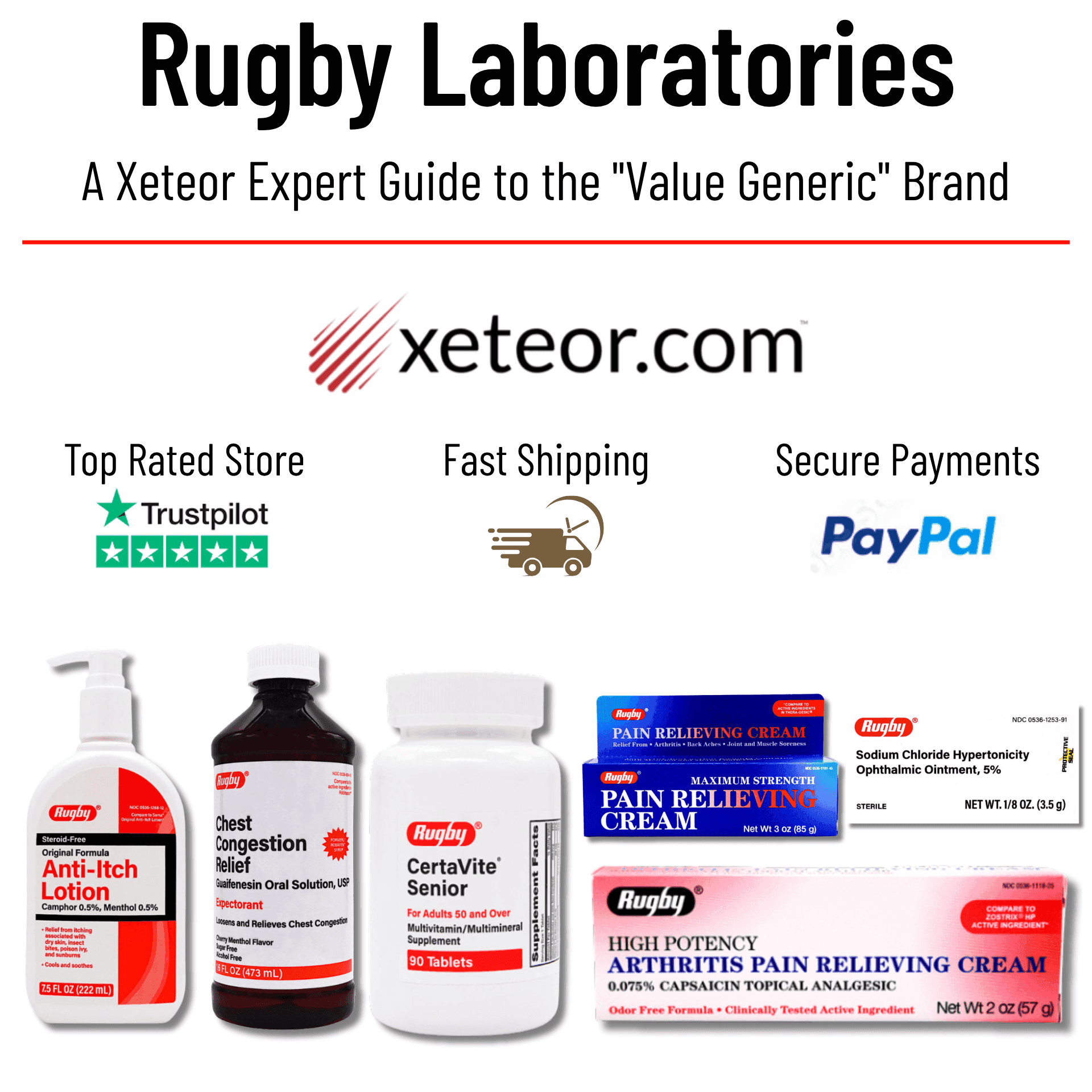
Tier 3 Value Generics are traditional pharmacy labels that many customers recognize from years of use. Major Pharmaceuticals and Rugby Laboratories are two of the best-known examples in Xeteor's catalog.
These brands have historically offered affordable alternatives to more heavily marketed consumer products. However, their traditional value positioning does not mean every product is the lowest-priced option today.
Unlike a vertically integrated manufacturer that produces many of its own medications, a pharmaceutical labeler may rely on third-party manufacturers to produce finished products sold under its name. This can create additional sourcing relationships between the factory, labeler, distributor, and retailer.
Major Pharmaceuticals & Rugby Laboratories
These long-standing pharmacy labels offer numerous familiar OTC medicines. Depending on the product, the company named on the package may be the labeler rather than the actual manufacturing establishment. Production sources, packaging, inactive ingredients, and availability can change over time.
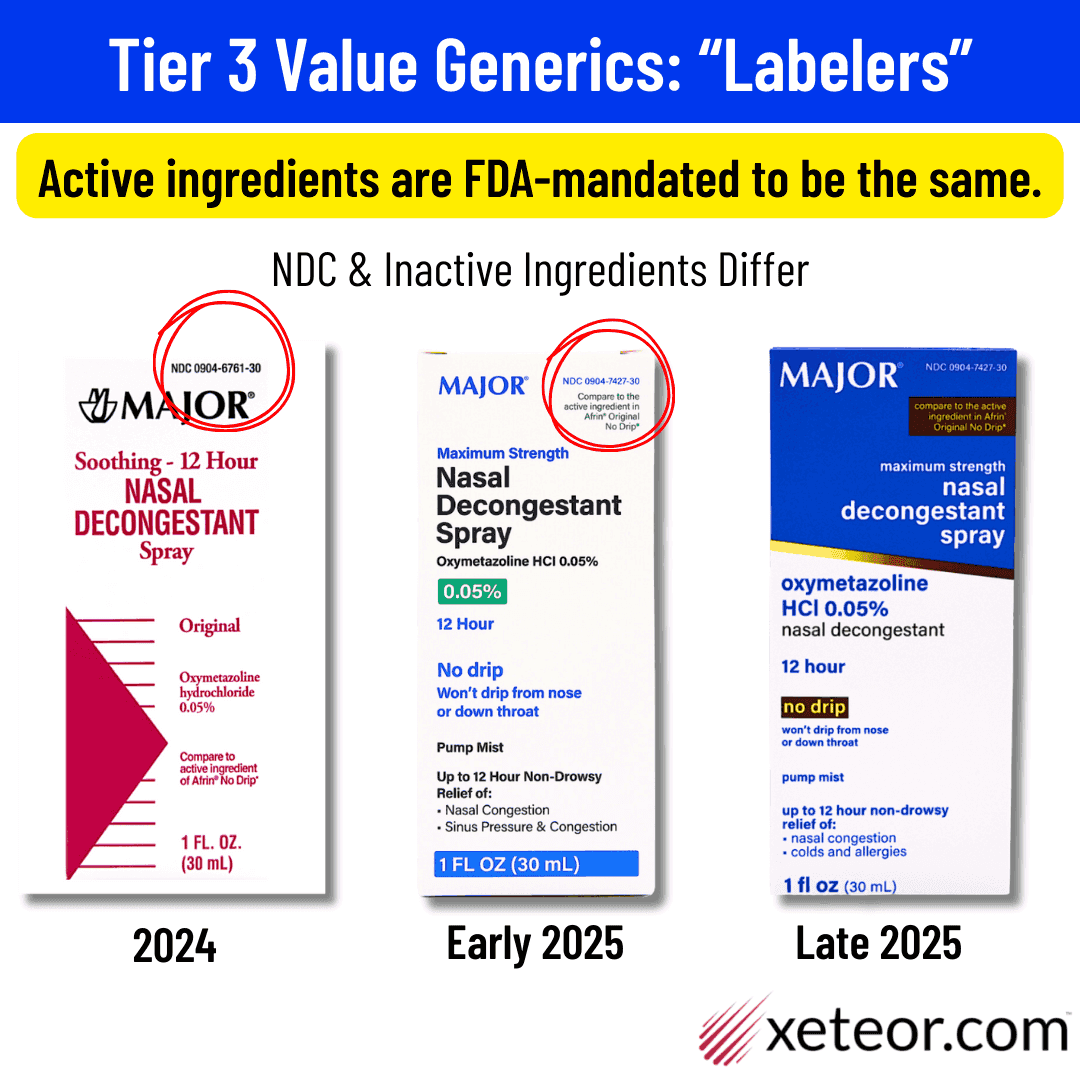 Changes in product identifiers and sourcing can help illustrate how a legacy pharmacy label may obtain products from different manufacturing establishments.
Why Are Rugby and Major Pharmaceuticals Prices Increasing?
Quick answer: During 2026, Xeteor has experienced repeated wholesale acquisition cost increases on selected Rugby Laboratories and Major Pharmaceuticals OTC products. Both brands have historically been associated with affordable pharmacy generics, but manufacturing arrangements, sourcing costs, distribution decisions, and product availability can affect the prices retailers pay to replenish inventory.
This is an important distinction: a product can remain the same medication while becoming significantly more expensive to purchase. A price increase does not necessarily indicate a change in quality, ingredients, or effectiveness.
How Third-Party Manufacturing Can Affect Generic Prices
A pharmaceutical labeler and the actual manufacturer are not necessarily the same company.
When a company relies on third-party manufacturers to supply finished medications, it may have less direct control over production costs. Changes in contract manufacturing prices, raw materials, product sourcing, production capacity, or purchasing terms can affect wholesale acquisition costs.
These increases may pass through the supply chain:
- A manufacturing facility produces the medication.
- A pharmaceutical labeler purchases or sources the finished product.
- Wholesale distributors acquire and supply the product.
- Retailers purchase inventory and establish selling prices.
When costs increase at one or more stages, the final retail price may rise even when the medication's active ingredient and strength remain unchanged.
What Xeteor has observed: Selected Rugby and Major OTC products have experienced substantial wholesale cost increases during 2026. While third-party manufacturing can create exposure to upstream cost changes, we cannot attribute every individual price increase to a specific factory or supplier decision without additional evidence.
Why Perrigo and Other Tier 1 Brands May Have More Pricing Stability
One reason Xeteor distinguishes between generic sourcing tiers is the degree of manufacturing and distribution control behind the brand.
Perrigo, the company behind GoodSense, operates its own pharmaceutical manufacturing facilities and has significant scale in OTC production. This gives it a different sourcing structure from brands that rely primarily on purchasing finished medications from outside manufacturers.
Greater manufacturing control may provide more flexibility in managing production schedules, sourcing, and manufacturing expenses. However, it does not guarantee that prices will remain unchanged.
McKesson, which backs Foster & Thrive, offers a different advantage: its extensive healthcare distribution network. That scale can provide substantial purchasing and distribution capabilities even where individual products are made by outside manufacturers.
In Xeteor's purchasing experience, many GoodSense, Foster & Thrive, and other generic products have maintained comparatively stable wholesale pricing during 2026, while selected Rugby and Major products have experienced repeated increases.
This observation describes Xeteor's actual acquisition costs. It does not mean every Perrigo or McKesson product has remained unchanged in price throughout the industry.
How Narrower Distribution Can Add Pricing Pressure
Manufacturing is only one part of the equation. Distribution strategy also influences availability and purchasing flexibility.
When a pharmaceutical brand places greater emphasis on a narrower group of preferred sales outlets, other retailers may have fewer practical sourcing options. This can reduce purchasing flexibility when inventory becomes limited or acquisition costs rise.
A more concentrated sales-channel strategy does not automatically cause higher prices. However, when combined with third-party manufacturing relationships and changing wholesale costs, it can contribute to a more challenging sourcing environment for independent retailers.
The extent to which these factors explain individual Rugby or Major price increases cannot be established from retail pricing observations alone.
Why Tier 3 Value Generics Aren't Always the Lowest Price
For years, many customers associated Rugby and Major with dependable, economical OTC medications. They can still be excellent purchases, especially when a specific product remains competitively priced.
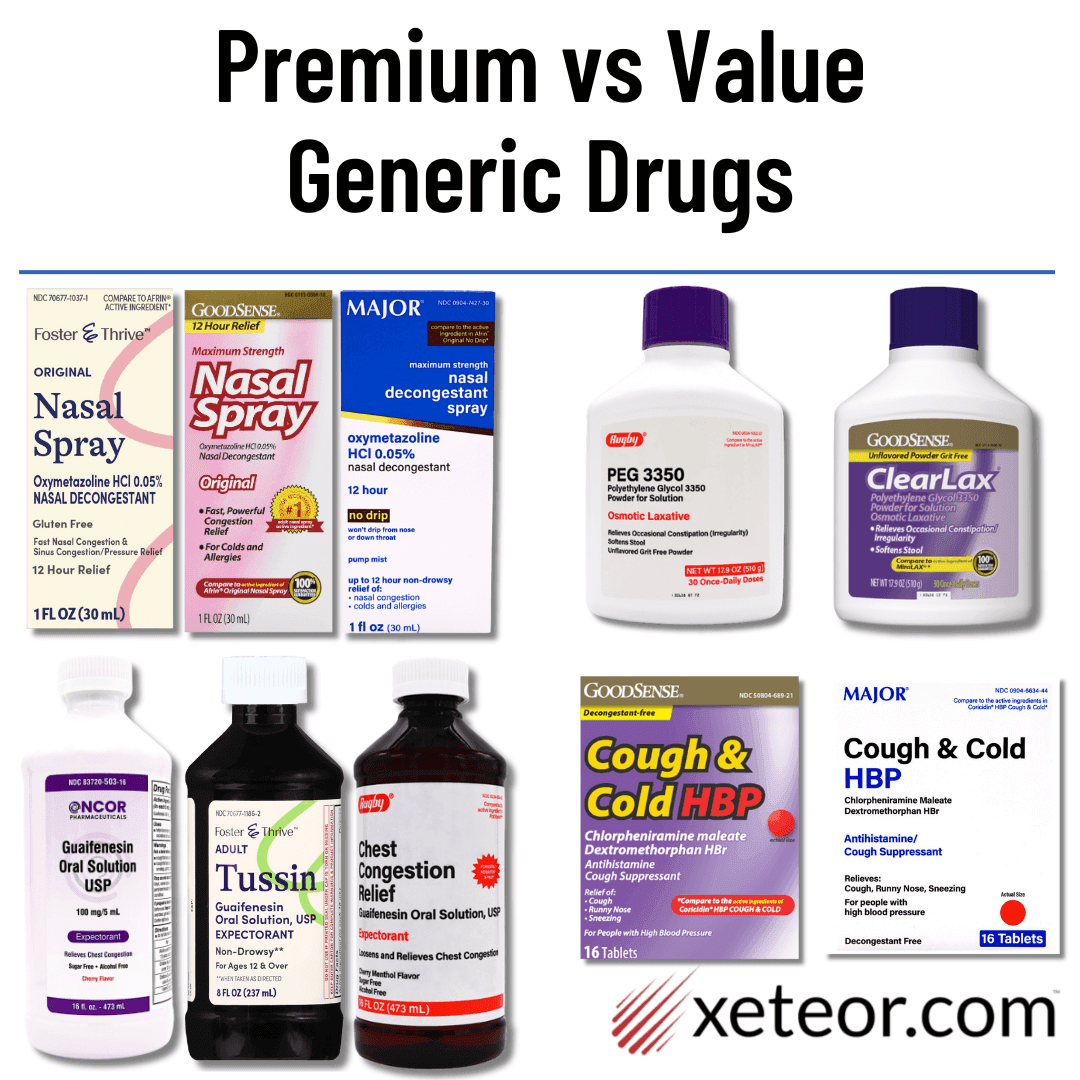
But when wholesale costs rise, an alternative from a different sourcing network may provide better value. That alternative may come from Tier 1 brands like GoodSense or Foster & Thrive or Tier 2 brands like Geri-Care, Health Star, Reliable 1, or Oncor.
When evaluating an alternative, Xeteor checks:
- Whether the active ingredient and strength match
- Whether the dosage form and intended use are appropriate
- Whether the product is consistently available
- Whether the package size and delivered price make sense
- Whether another manufacturer or sourcing route offers better practical value
A real customer example: A customer recently described a significant increase in the retail price of a Rugby ointment, from $15.99 to $24.99, in a review of Xeteor. This illustrates how changes in product pricing can affect longtime customers who rely on familiar OTC medications.

The review documents the customer's experience with a higher retail price. It does not, by itself, establish the cause of the underlying wholesale cost increase.
The takeaway: Tier 3 does not mean lower quality, and Tier 1 does not necessarily mean a higher price. The value of a generic medication depends on current sourcing conditions, product availability, formulation, and total delivered cost.
Why are Rugby and Major Pharmaceuticals products more expensive in 2026?
Xeteor has experienced substantial wholesale cost increases on selected Rugby Laboratories and Major Pharmaceuticals products. These legacy pharmacy labels may depend on third-party manufacturing and sourcing arrangements, while changes in distribution can affect purchasing flexibility. The precise causes of individual price increases may vary. Customers should compare current prices rather than assume a historically inexpensive generic label will always offer the lowest cost.
Can GoodSense or another generic brand cost less than Rugby or Major?
Yes. A differently sourced generic can sometimes offer a lower total price, even if it belongs to Xeteor's Tier 1 or Tier 2 category. Always compare the active ingredient, strength, dosage form, intended use, package quantity, and delivered price before choosing an alternative.
The "Labeler" Concept in Action: Who Really Makes Your Antacid?
To understand how Tier 3 Value Generics work, consider a real-world example involving Major Mintox Liquid Antacid.
If you look up Major Mintox Liquid Antacid in the FDA's DailyMed database, you can examine information about the product's labeler and manufacturing establishment. Click "VIEW ALL SECTIONS" and look toward the bottom of the drug listing.
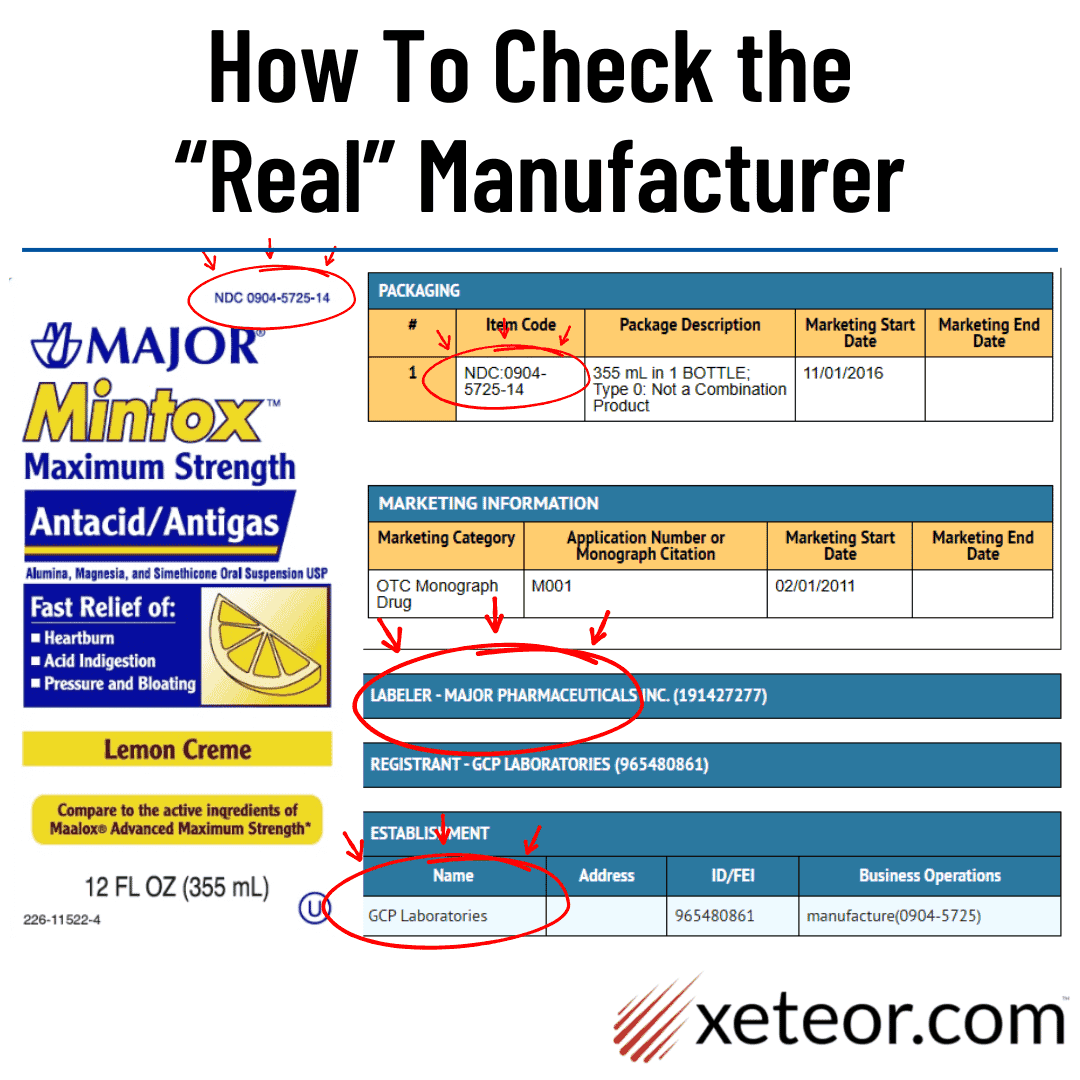
The Smart Swap: GCP Laboratories is associated with Geri-Care Pharmaceuticals. The cited DailyMed record provides an example of how a product can carry the Major label while identifying a different manufacturing establishment.
This distinction helps explain why two products from competing generic labels may have connections to the same manufacturing network.
For example, shoppers considering Major Mintox can also review Geri-Care Geri-Mox or Foster & Thrive Liquid Antacid, depending on the required active ingredients and strength.
For more background on Geri-Care's product line, visit our Geri-Care guide.
Xeteor Substitution Map: Examples
When a familiar generic becomes unavailable, expensive, or inconsistent, Xeteor doesn't simply recommend a random replacement. We compare active ingredients, strength, format, availability, and total delivered value.
| Customer Starts With | Xeteor Route | Why |
|---|---|---|
| Major Docusate Sodium 100 mg | Geri-Care Docusate Sodium 100 mg | An institutional alternative with the same active ingredient and strength. |
| Rugby B-Complex with B-12 | Geri-Care Vitamin B-Complex | A potential vitamin alternative when Rugby becomes unavailable. Compare Supplement Facts for exact nutrient amounts. |
| Rugby Therems Multivitamin | Geri-Care Thera Multivitamin 12-Pack | A bulk alternative for repeat users comparing Theragran-style multivitamins. |
| Major Banophen Diphenhydramine 25 mg | Geri-Care Geri-Dryl Diphenhydramine 25 mg | Keeps the active ingredient and strength aligned while changing the dosage form from capsules to tablets. |
| Rugby Sodium Chloride 5% Solution | Reliable 1 Sodium Chloride 5% Solution | An alternative 5% ophthalmic sodium chloride solution when the Rugby label is not the best value. |
| Major Nasal Spray | GoodSense Nasal Spray Original | A manufacturer-backed OTC alternative with comparable active ingredients and a different package size. |
| Rugby Reguloid Psyllium Husk | Foster & Thrive Psyllium Fiber Powder | An alternative psyllium fiber formulation when available, with package size and directions compared separately. |
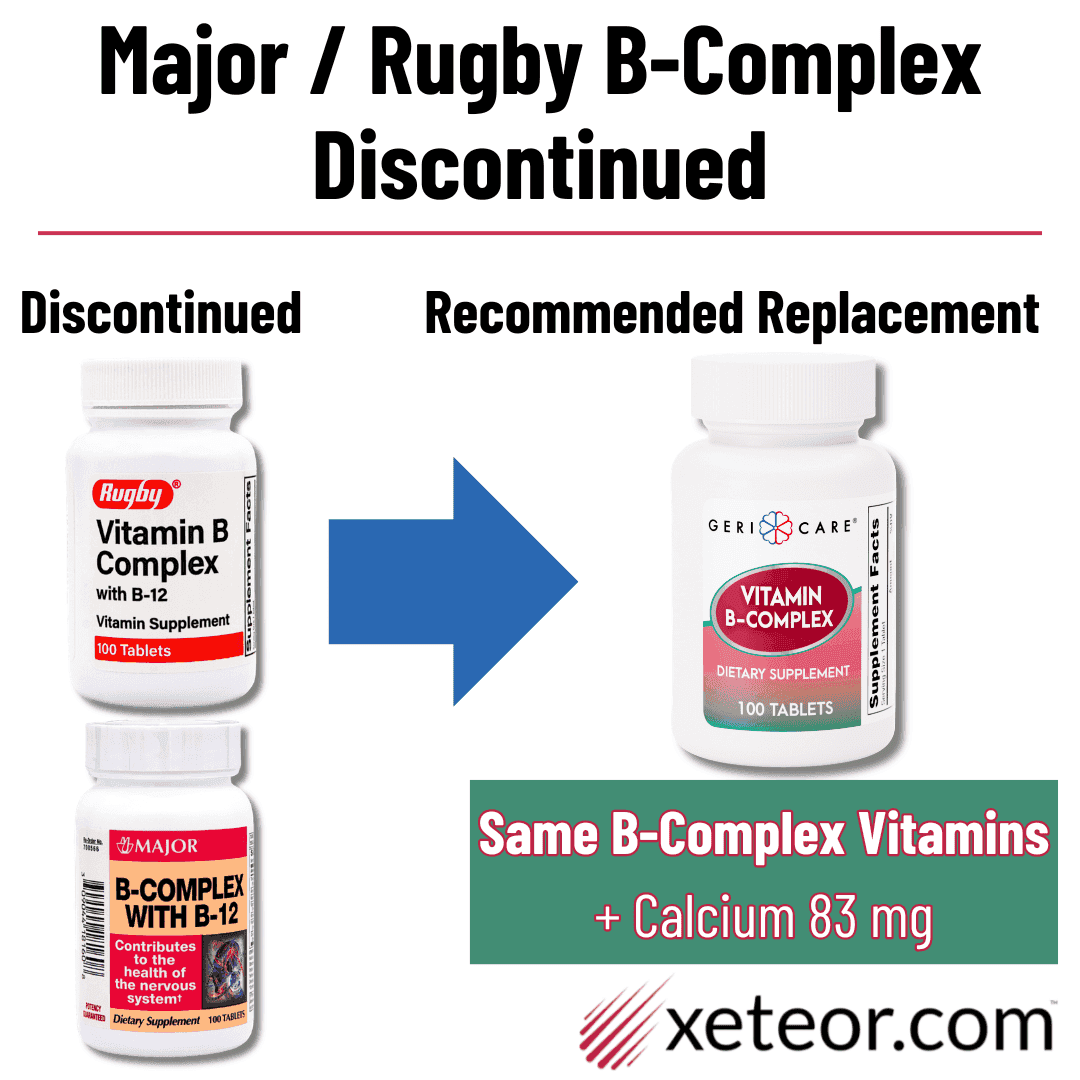 An example of how Xeteor compares discontinued or hard-to-find legacy vitamin products with available alternatives.
What Does "Compare to the Active Ingredient" Mean?
Many OTC generics display wording such as "Compare to the active ingredient in" a familiar name-brand medication.
In plain English, this typically indicates that the product contains the same stated active ingredient and strength as the referenced brand-name product.
- Active ingredient: The medicinal ingredient responsible for the product's intended effect.
- Strength: The quantity or concentration of that active ingredient.
- Intended use: The symptoms or condition the medication is labeled to address.
However, "compare to" doesn't necessarily mean the products are identical in every way. Differences may include:
- Inactive ingredients, dyes, sweeteners, preservatives, or flavorings
- Dosage form, texture, taste, or packaging
- Manufacturer or pharmaceutical labeler
- Availability and sourcing arrangements
- Package size and delivered price
That's where Xeteor's tier system comes in. Two products can contain the same active ingredient while having different sourcing arrangements and retail prices.
The takeaway: Active ingredients help establish whether two medicines are appropriate to compare. The Xeteor tier system helps shoppers assess sourcing, availability, and practical value.
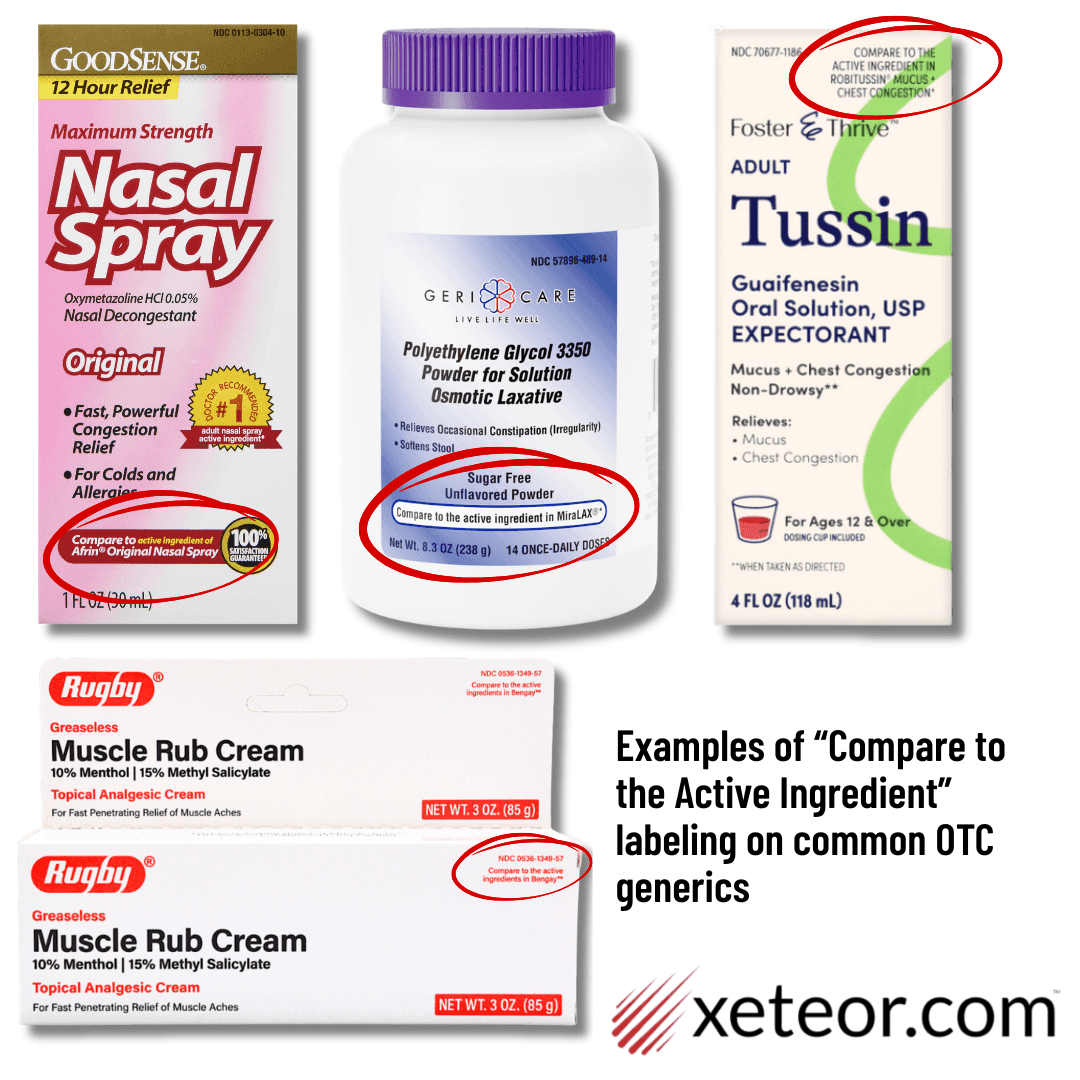 Examples of OTC labeling that identifies an active ingredient comparison with a familiar brand-name medicine.
What to Do When Generic Medications Go Out of Stock
Supply-chain challenges can affect any OTC medicine, but they are especially relevant when a brand depends on sourcing finished products through multiple companies or distribution arrangements.
Customers frequently encounter availability changes in categories such as stool softeners, fiber supplements, antacids, multivitamins, cough medications, allergy products, and hard-to-find legacy pharmacy labels.
Our recommendation: When a product becomes difficult to find, unusually expensive, or inconsistent in availability, don't rely on the label name alone. Look for the closest practical alternative.
- Step 1: Match the active ingredient and strength whenever possible.
- Step 2: Check the formulation and dosage form, such as liquid versus tablet or cream versus ointment.
- Step 3: Look for appropriate Tier 2 alternatives from Health Star (Geri-Care), Reliable 1, or Oncor.
- Step 4: Compare Tier 1 products from GoodSense (Perrigo) or Foster & Thrive (McKesson).
Our goal is to help customers find appropriate formulations with reliable availability and competitive delivered pricing, rather than pursue a familiar label regardless of cost.
The key idea: Choosing a generic involves more than comparing brand names. Manufacturing arrangements, supply continuity, package quantities, and current acquisition costs can all influence value.
Manufacturing Deep Dive: When Sourcing Fails
Most customers don't need to study manufacturing records to purchase OTC medicine. But when a product becomes unavailable, changes source, or suddenly costs more, the underlying manufacturing arrangements may matter. For an additional industry example involving pharmaceutical manufacturing and quality-control issues, see this independent report.
Read the Industry Report on RepublicPharma.com →
Premium vs Value Generic Drugs Summary: Xeteor Generic Brand Hierarchy
The following table summarizes Xeteor's generic brand classifications according to sourcing arrangements, supply-chain backing, manufacturer characteristics, and practical customer use.
| Brand / Manufacturer | Xeteor Tier | Best Used For | Routing Role |
|---|---|---|---|
| GoodSense / Perrigo | Tier 1 | Everyday OTC essentials | Manufacturer-backed consumer alternatives with established OTC production infrastructure. |
| Foster & Thrive / McKesson | Tier 1 | Healthcare distribution and retail OTC | Large-distributor-backed alternatives with familiar consumer packaging. |
| Geri-Care / Health Star | Tier 2 | Senior care, institutional OTC, bulk quantities | Alternative formulations and package sizes when legacy value labels are less competitive. |
| Reliable 1 Laboratories | Tier 2 | Eye care and specialty OTC | Alternative sourcing for matching specialty products. |
| Oncor Pharmaceuticals | Tier 2 | Liquid OTC medicines | Alternative liquid medication sourcing. |
| Major / Rugby | Tier 3 | Legacy pharmacy demand | Traditional value labels that remain useful when availability and current pricing are competitive. |
Bottom Line: Premium vs Value Generic Drugs
The best generic isn't always the least expensive historical brand, the most familiar label, or the product you purchased previously. The best practical choice combines appropriate active ingredients, formulation, availability, delivered value, and reliable sourcing.
- Tier 1 Premium Generics: Manufacturer-backed or major-distributor-backed brands for customers prioritizing familiar OTC packaging and large-scale supply relationships.
- Tier 2 Standard Generics: Institutional, specialist, senior-care, or bulk-oriented alternatives.
- Tier 3 Value Generics: Legacy pharmacy labels that remain worthwhile when their prices and availability are competitive.
During 2026, Xeteor has seen how quickly historically inexpensive Rugby and Major products can become more expensive to source. That experience reinforces the purpose of our three-tier system: finding the best practical generic alternative rather than assuming one brand will always provide the lowest price.
Looking for Zyrtec or Claritin Generic Comparisons?
Many shoppers also have questions about generic Zyrtec, cetirizine, loratadine, generic Claritin, and the differences between brand-name and generic allergy products.
For ingredient-specific comparisons, explore these guides:
- Zyrtec vs. Claritin: Which Is Better?
- Zyrtec Generic Alternatives Guide
- Claritin Generic Alternatives Guide
Interested in prescription generics? Our Xeteor Rx Quality Ladder discusses a related three-tier sourcing framework for prescription medications. It is an educational comparison, not a clinical ranking or a recommendation to change prescriptions.
Find More About Premium vs Value Generic Drugs in Our Expert-Curated Hubs
Our approach to comparing generic sourcing and substitutions is reflected throughout Xeteor's educational guides. Explore these hubs for ingredient comparisons, product alternatives, and shopping information.
- Cough, Cold & Flu Hub
- Digestive Health Hub
- Pain Relief Creams Hub
- Vitamins & Supplements Hub
- Eye Care Hub
- Hair & Scalp Hub (Coming Soon)
Premium vs Value Generic Drugs: Shop Brands Mentioned
Geri-Care Geri-Tussin Liquid Guaifenesin 100 mg - 16 fl oz | Compare to Robitussin
$13.99
Geri-Care Geri-Tussin Liquid Guaifenesin 100 mg / 5 mL – 16 fl oz | Compare to Robitussin® Effective Mucus Relief to Make Coughs More Productive… read more
View Product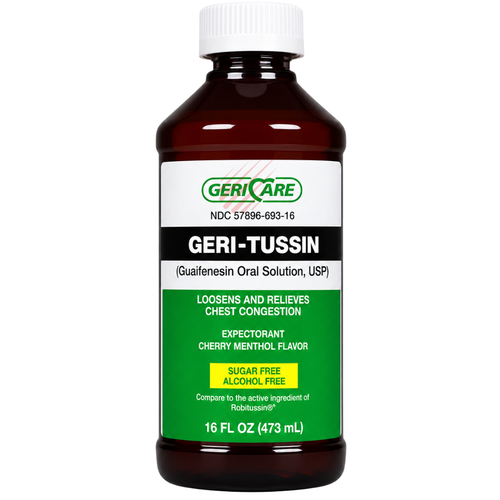
Geri-Care Geri-Mox Antacid Liquid Mint Flavor - 12 fl oz | Compare to Maalox Advanced
$11.99
Geri-Care Geri-Mox Antacid & Anti-Gas Liquid, Mint Flavor – 12 fl oz | Compare to Maalox® Advanced Fast-Acting Multi-Symptom Relief for Heartburn and Gas Geri-Care… read more
View Product
Major Nasal Decongestant Spray - 1 fl oz | Compare to Afrin No Drip
$9.99
Major Nasal Decongestant Spray – Oxymetazoline HCl 0.05% – 1 fl oz | Compare to Afrin® No Drip Fast, 12-Hour Relief from Nasal Congestion and… read more
View Product
Perrigo Cetirizine Hydrochloride 10 mg - 300 Tablets | Zyrtec (2 Pack)
$29.99
Cetirizine Hydrochloride 10 mg – 600 Tablets (2 Pack) | Generic Zyrtec® by Padagis / Perrigo Stock Up & Save: Bulk Allergy Relief + Free… read more
View Product
GoodSense Allergy Relief Diphenhydramine 25 mg - 100 Tablets | Compare to Benadryl (4 Pack)
$11.99
GoodSense® Allergy Relief Diphenhydramine HCl 25 mg – 100 Tablets (4-Pack Bundle) | Compare to Benadryl® Allergy Maximum Value Supply: Professional-Grade Multi-Symptom Relief for Allergies… read more
View Product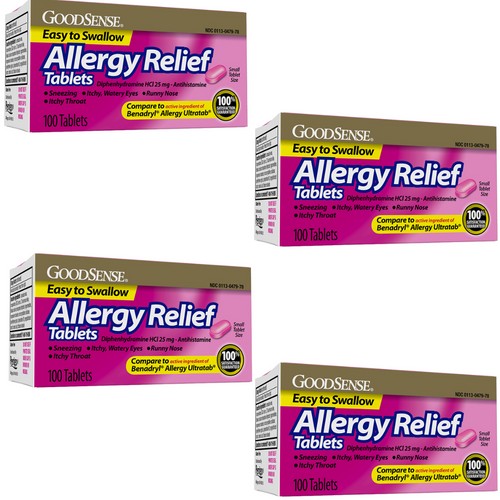
Foster & Thrive Nasal Spray - 1 fl oz | Compare to Afrin Original (5 Pack)
$29.95
Foster & Thrive Nasal Decongestant Spray – Oxymetazoline HCl 0.05% – 5-Pack (5 fl oz Total) | Compare to Active Ingredient in Afrin® Original Stock… read more
View Product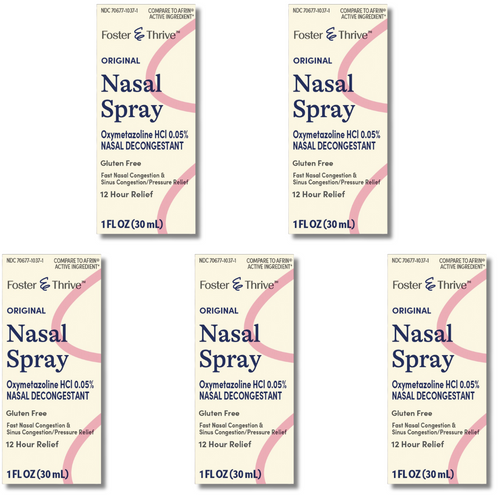
GoodSense Cough & Cold HBP - 16 Tablets | Compare to Coricidin HBP
$5.79
GoodSense Cough & Cold HBP – 16 Tablets | Safe for High Blood Pressure Effective cold relief for people managing hypertension. GoodSense Cough & Cold… read more
View Product
Oncor Guaifenesin 100 mg Cough Syrup - 16 fl oz | Robitussin (3 Pack)
$27.99
Oncor Guaifenesin Liquid 100 mg/5 mL – 16 fl oz (3 Pack) | Compare to Robitussin® Chest Congestion Stock Up & Save: Sugar-Free, Alcohol-Free Relief… read more
View Product
GoodSense Nasal Spray Original - 1 fl oz | Compare to Afrin Original (6 Pack)
$24.99
GoodSense® Nasal Spray Original 12-Hour – 1 fl oz (6 Pack) | Compare to Afrin® Original Stock Up and Save on Fast, 12-Hour Relief from… read more
View Product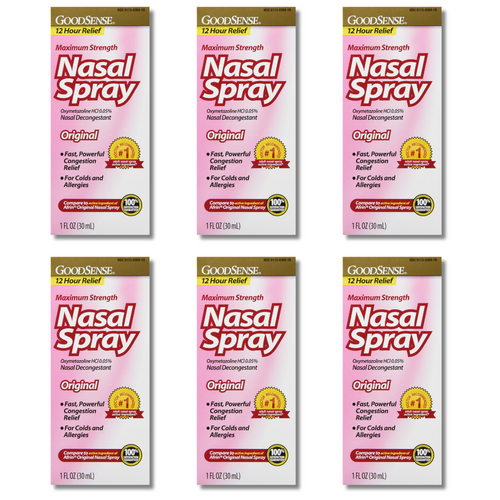
GoodSense Allergy Relief Loratadine 10 mg - 90 Tablets | Compare to Claritin
$4.99
GoodSense® Allergy Relief Loratadine 10 mg - 90 Tablets Compare to the active ingredient of Claritin® Tablets Find powerful, non-drowsy relief from common indoor and… read more
View Product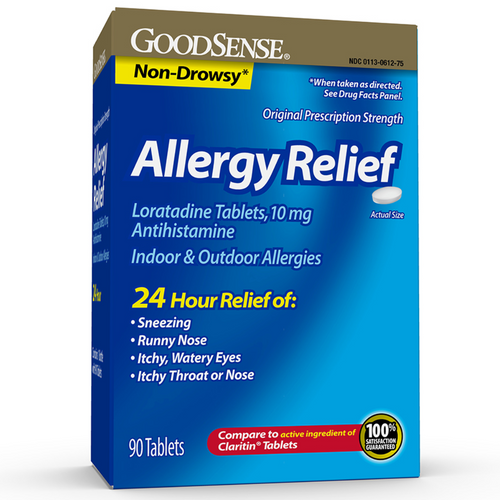
About Xeteor
Xeteor.com, founded in Las Vegas in 2018, is a trusted online store and healthcare product guide specializing in generic over-the-counter medicines, store-brand alternatives, blood glucose test strips, diabetic testing supplies, vitamins, and healthcare essentials.
We help shoppers find the right product when a brand name is too expensive, a store-brand label is confusing, insurance is not being used, or the product they usually buy is out of stock. For OTC products, our approach compares active ingredients, strengths, dosage forms, package sizes, manufacturers, pricing, availability, and fulfillment options. For diabetic testing supplies, we help customers compare meter compatibility, test strip type, expiration dating, package count, price per strip, and out-of-pocket value.
Our product analysis is led by Joe, the Head Xeteorologist, whose Joe’s Translation insights explain generic OTC products and diabetes supply choices in plain English.
We are the creators of the Xeteor Rx Quality Ladder and the Premium vs. Value Generic Drugs framework. These guides help explain how generic OTC products differ by manufacturer, labeler, sourcing model, supply reliability, and delivered value.
Our OTC generic portfolio includes:
- Tier 1 Premium Generics: GoodSense and Foster & Thrive.
- Tier 2 Standard Generics: Geri-Care, Reliable 1 Laboratories, Oncor Pharmaceuticals, and Health Star.
- Tier 3 Value Generics: Major Pharmaceuticals and Rugby Laboratories.
Many customers also come to Xeteor.com for affordable cash-pay diabetic testing supplies, especially blood glucose test strips, meters, lancets, control solution, and related diabetes supplies. Explore our Diabetes Management Guides, including guides for CareSens Test Strips, True Metrix Test Strips, and Original Bayer Contour Test Strips.
Xeteor is top-rated across major platforms including Trustpilot, Google, eBay, Amazon, and Walmart, with over 10,000 customer reviews across major platforms. Our goal is to combine clear product guidance, reliable products, and real human support by phone, email, and text.
For more plain-English comparisons, visit the Xeteor OTC & Diabetes Guides.
Shipping
Orders placed by 3:00 PM PST, Monday through Friday, usually ship the same business day when fulfilled directly from Xeteor. Network and partner-fulfilled items usually ship within 1 to 2 business days through trusted healthcare distribution partners.
We offer free nationwide shipping on orders over $30 and on qualifying Savings Packs. Some orders may ship in multiple packages if items are fulfilled from different locations. View our full shipping policy.
Payment Methods
We accept Visa, Mastercard, Discover, American Express, PayPal, Venmo, Google Pay, and Apple Pay.
Returns
Purchases are backed by our 100-day return policy. We accept eligible unopened, unused items in their original packaging, with no restocking fees. View our complete return policy.
Need Help?
We’re here for you. Reach out via:
- Phone: 1-833-787-4777 (Monday-Friday, 9 AM-5 PM PST)
- Email: cs@xeteor.com
- Text: 702-659-7022
Visit our full Contact Xeteor Customer Service page for more options.
Disclaimer: This content is for informational purposes only and is not a substitute for professional medical advice. Always read and follow the product label. If you have a medical question, ask your doctor, pharmacist, or other qualified healthcare professional.
Important: Xeteor.com sells over-the-counter products, diabetic testing supplies, vitamins, and healthcare essentials. We do not sell, dispense, or fulfill prescription medications. OTC generic comparisons are based on factors such as active ingredient, strength, dosage form, package size, labeling, availability, and practical use case. Diabetes testing supplies must be compatible with the meter or device being used. Inactive ingredients, packaging, taste, texture, sourcing, expiration dating, and fulfillment path can vary.
Frequently Asked Questions
What is the difference between Tier 1, Tier 2, and Tier 3 generic medications?
Xeteor's three-tier system classifies generic brands by their manufacturing relationships, sourcing models, and supply-chain characteristics—not by whether the medicine is more or less effective. Tier 1 Premium Generics include manufacturer-backed or major-distributor-backed brands like GoodSense and Foster & Thrive. Tier 2 Standard Generics include institutional and specialist brands like Geri-Care and Reliable 1. Tier 3 Value Generics include traditional pharmacy labels like Rugby Laboratories and Major Pharmaceuticals. A higher tier does not automatically mean better medicine or a higher price.
Why are Rugby Laboratories and Major Pharmaceuticals prices increasing?
During 2026, Xeteor has experienced substantial wholesale cost increases on selected Rugby and Major products. These brands use third-party manufacturing and sourcing arrangements, which can expose them to changes in upstream production and acquisition costs. A narrower distribution strategy may also reduce purchasing flexibility. While these factors can contribute to pricing pressure, the exact cause of each increase may vary.
Why can GoodSense and other Tier 1 generics cost less than Rugby or Major?
GoodSense is backed by Perrigo, a major OTC manufacturer with its own production facilities. This manufacturing infrastructure can provide greater control over production and sourcing costs than brands relying on outside manufacturers. Xeteor has experienced comparatively stable wholesale pricing on many GoodSense products during 2026, while selected Rugby and Major products have become more expensive. However, Tier 1 does not guarantee the lowest price, and customers should compare equivalent products.
What is the difference between a pharmaceutical manufacturer and a labeler?
A pharmaceutical manufacturer produces the medication, while a labeler markets or distributes a product under its own name. Some pharmaceutical companies perform both functions, while others obtain finished medications from outside manufacturers. For example, certain Major Pharmaceuticals products have been manufactured by GCP Laboratories, which is associated with Geri-Care. Understanding these relationships helps explain why different generic brands may share manufacturing sources but have different prices and availability.
Are generic medications as effective as brand-name medications?
FDA-approved generic drugs must meet applicable standards for active ingredients, strength, quality, and performance compared with their reference products. Many OTC medications are also marketed under FDA monograph requirements rather than individual generic-drug approvals. Products with matching active ingredients and strengths can provide comparable treatment options when their formulations and labeled uses align. Differences in inactive ingredients, dosage forms, and individual preferences may still matter. Xeteor's tier system evaluates sourcing and practical value, not clinical superiority.